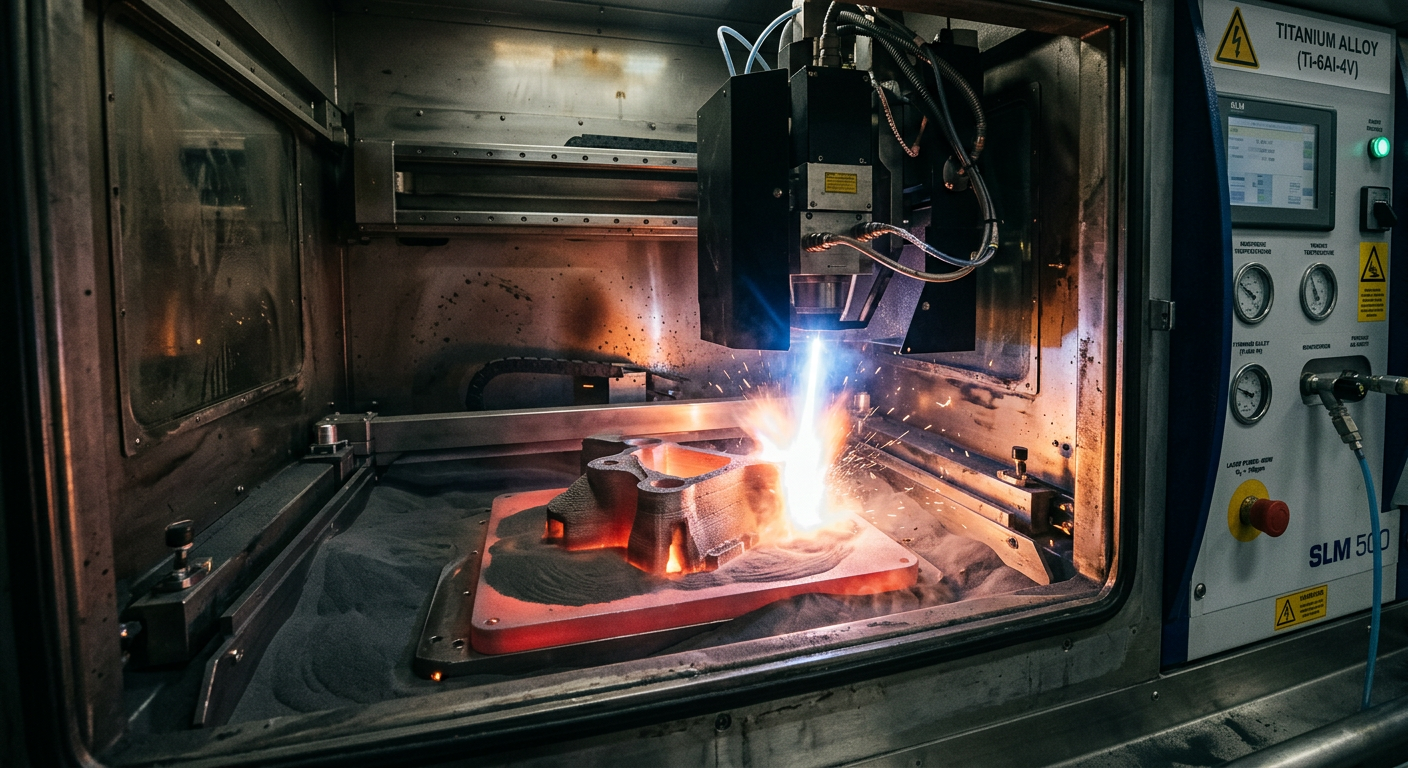
DMLS titanium parts contain two categories of defects that post-processing must address: residual stress (from rapid thermal cycling during sintering) and microporosity (from incomplete fusion, gas entrapment, or lack-of-fusion defects). Stress relief and HIP address these separately.
Stress Relief: Required for All Structural Parts
Residual stress in DMLS titanium reaches 600–900 MPa — comparable to the yield strength of the material itself. Without stress relief, parts will distort on support removal and may fail prematurely under cyclic loading.
Standard cycle: 800°C / 2 hours / vacuum furnace / controlled cooling at 5°C/min.
This is the minimum post-processing requirement for any structural DMLS titanium part. It does not eliminate porosity.
HIP: Required for Fatigue-Critical Applications
Hot isostatic pressing (HIP) applies simultaneous heat and pressure to close subsurface porosity. The standard cycle for Ti6Al4V: 900°C / 100 MPa argon / 2 hours.
HIP increases fatigue life by 3–5× versus stress-relief-only parts by eliminating the stress concentrations at pores that initiate fatigue cracks. It is mandatory for:
- Rotating aerospace components (fan blades, impellers)
- Structural flight hardware with defined fatigue life
- Orthopedic implants subjected to millions of load cycles
HIP does not eliminate surface porosity (open pores). Surface finish post-processing (machining, electropolishing) is required separately.
Decision Matrix
| Application | Stress Relief | HIP | Rationale |
|---|---|---|---|
| Non-structural brackets | ✓ | Optional | Distortion control only |
| Static structural | ✓ | Recommended | Improved ultimate strength |
| Fatigue-critical (aerospace) | ✓ | Required | Fatigue life mandate |
| Medical implants | ✓ | Required | Cyclic loading in vivo |
| Research/prototype | ✓ | Optional | Cost optimization |
Cost Consideration
HIP adds $200–$800 per batch (not per part) depending on furnace size. For small runs of high-value parts, the per-part cost premium is modest relative to part value. For prototype quantities, HIP is often deferred until design validation.