Why Sustainability Matters in Titanium Aerospace Manufacturing
Conventional machining of titanium aerospace components is wasteful. The usual measure is the buy-to-fly ratio: the amount of raw material purchased compared with the amount that ends up in the finished part. Sustainable titanium aerospace printing offers a direct path to reducing this waste, because additive manufacturing builds parts layer by layer instead of cutting them out of a larger block.
Titanium is also costly to produce in the first place. The Kroll process, which reduces titanium ore to a porous metallic “sponge”, is still predominantly used for commercial production, and the complexity of its batch production is cited as a reason for titanium’s relatively high market value. Material that is machined away has already carried that upstream cost.
How Additive Manufacturing Reduces Titanium Waste
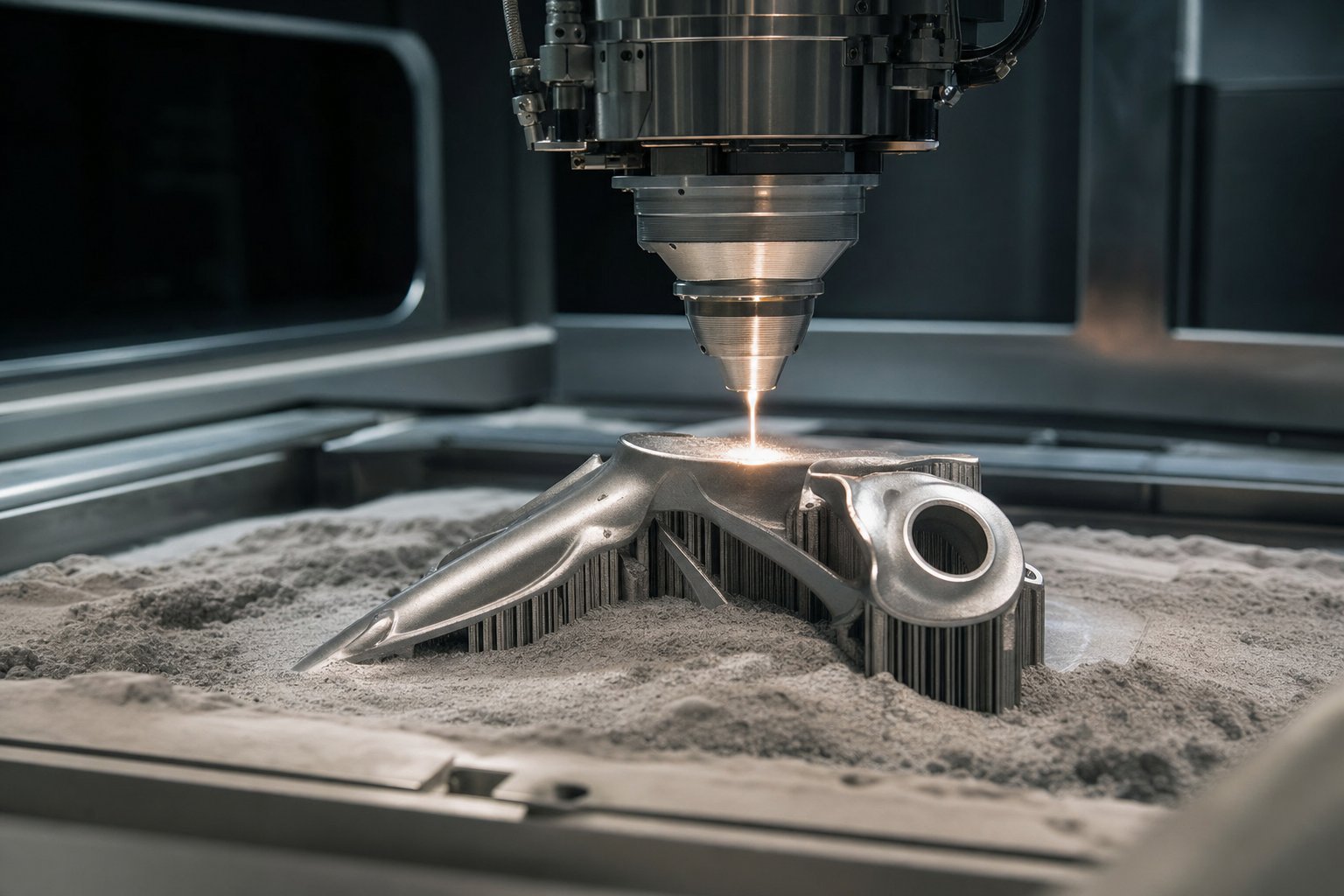
The U.S. Department of Energy’s Quadrennial Technology Review 2015 gives a worked example. A titanium aerospace bracket, of the kind used to fix cabin structures such as galleys and lavatories, is typically produced by conventional milling and machining with a buy-to-fly ratio of 8:1. A bracket with the same function but a topologically optimized geometry can be produced by electron beam melting (EBM) with a buy-to-fly ratio of 1.5:1.
In the same example the optimized bracket is 65% lighter. The review notes that this saves manufacturing material and also produces energy savings during the use phase, which matters for aerospace components with long service lives. In its life-cycle table for the bracket, the energy embodied in the material and the energy consumed in use are both far lower for the additive version, while the manufacturing energy itself is about the same for the two routes.
Topology Optimization and Lightweighting
Topology optimization is a mathematical method that optimizes the layout of material within a given design space, for a given set of loads and constraints. It is a key part of design for additive manufacturing, because printing can produce the resulting shapes directly. The bracket in the Department of Energy example shows the two effects working together: less raw material bought, and less mass carried for the life of the aircraft.
Titanium Powder Recycling and Reuse
One of the central sustainability questions in powder-based titanium printing is how many times powder can be reused. A 2015 study in the journal JOM by Tang and co-authors reused the same batch of Ti-6Al-4V powder 21 times in selective electron beam melting. The oxygen content of the powder increased progressively with the number of reuse cycles, and the particles became less spherical. The aluminum and vanadium contents stayed generally stable, flowability improved, and the printed samples showed highly consistent tensile properties.
Managing Oxygen Pickup
The progressive rise in oxygen is the result to watch, because the Grade 5 composition for Ti-6Al-4V limits oxygen to a maximum of 0.2 wt%. Controlling the build atmosphere is part of the answer. Laser powder bed fusion takes place in a tightly controlled atmosphere of inert gas, either argon or nitrogen, with oxygen levels below 1000 parts per million. EBM takes place under vacuum, which makes it suited to reactive materials, and Ti-6Al-4V is among its commercial materials.
Upstream: Alternatives to the Kroll Process
The embodied cost of titanium is set before the metal reaches a printer, so extraction matters too. The FFC Cambridge process is an electrochemical method for producing titanium from titanium oxide by electrolysis in molten calcium salts. Research continues to seek cheaper and more efficient routes of this kind, but no method has yet commercially replaced the Kroll process.
Where the Industry Goes From Here
Sustainable titanium aerospace printing is not a solved problem. The documented gains are in material use and in the weight of the finished part, not in the energy drawn by the machine during a build. Powder can be reused many times, but its oxygen content rises as it is reused and has to stay within the alloy’s limit. The largest remaining cost sits upstream, in how titanium metal is extracted.
Sources
- U.S. Department of Energy, Quadrennial Technology Review 2015, Chapter 6 technology assessment: Additive Manufacturing
- Tang et al., “Effect of Powder Reuse Times on Additive Manufacturing of Ti-6Al-4V by Selective Electron Beam Melting”, JOM (2015)
- Wikipedia: Titanium (Kroll process status, alternative extraction routes)
- Wikipedia: Kroll process (titanium sponge)
- Wikipedia: FFC Cambridge process
- Wikipedia: Ti-6Al-4V (Grade 5 composition)
- Wikipedia: Selective laser melting (build atmosphere)
- Wikipedia: Electron-beam additive manufacturing (vacuum, materials)
- Wikipedia: Topology optimization
Fact-checked 2026-11-21